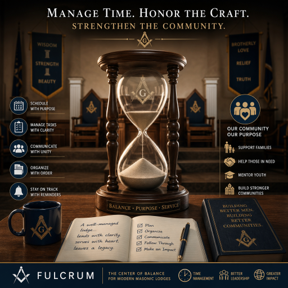
Every lodge has a center of gravity, an internal point of balance where people, purpose, and progress effortlessly align. When that center is steady, the lodge thrives. The work feels meaningful. When it drifts, however, even the most dedicated officers can feel as though they are constantly putting out fires rather than leading.
In Freemasonry, we speak often about our external duties: helping others, strengthening our communities, and improving ourselves. But there is a quiet truth we tend to overlook when we talk about doing good in the world:
A lodge cannot effectively help others until it can effectively manage itself.
And at the heart of that self-management is the most precious, non-renewable resource we possess: our time.
The Friction of Modern Lodge Life
Time is the quiet force that dictates our success. It determines whether officers step into a meeting feeling prepared or overwhelmed. It dictates whether committees move forward or stall, and whether the brethren on the sidelines feel engaged or left in the dark.
Freemasonry teaches order, structure, and purpose. Yet, look behind the curtain of almost any active lodge today, and you will find an administrative reality that is anything but orderly.
Our officers juggle an incredible load: coordinating degree work, tracking down RSVPs for dinners, managing member communications, untangling financial reporting, and organizing community volunteers. Most of this heavy lifting is done using a fractured web of group texts, lost emails, outdated spreadsheets, and sheer memory. It is no wonder that things fall through the cracks, or that good men burn out after their year in the East.
When time is mismanaged, the simplest tasks become heavy burdens. Energy fades. And most importantly, the lodge’s ability to serve its members and its community weakens.
The Community Cost of Administrative Burnout
A lodge does not exist for itself alone. We gather so that we might scatter, uplifting families, supporting local charities, and strengthening the fabric of the communities around us.
But meaningful community service requires more than just a passing of the hat; it requires coordination, consistent communication, and reliable follow-through. When a lodge is struggling internally just to get the minutes out or remind brethren of a practice, its ability to serve externally suffers.
Missed emails mean missed charitable opportunities. Disorganized planning results in fewer hands showing up to volunteer. But when a lodge regains control of its time, something powerful happens. We stop chasing paperwork and start building partnerships. A well-organized lodge becomes a force multiplier for good.
In this light, proper time management isn’t just an internal administrative benefit; it is a direct investment in your community.