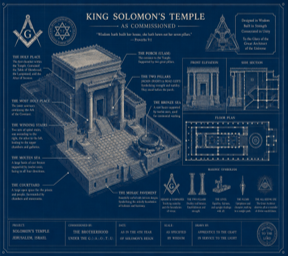
Although the image is distorted, the grand designs of King Solomon’s Temple were impressive. Today, we use modern technology to replicate the drawings and schemes that were done by hand, which our ancient brothers practiced during the building of this magnificent structure. However, King Solomon’s Temple is more than an ancient building. To the thoughtful Mason, it is a symbol of the inner life. Its stones, chambers, pillars, and sacred spaces point to a deeper truth: the building of the Temple reflects the building of the man.
Freemasonry teaches that a man is not made complete in a single moment. He is shaped over time. He learns, labors, corrects himself, and grows in wisdom. In this way, the Temple becomes a powerful image of moral and spiritual progress.
The Temple as a Blueprint for the Soul
The Entered Apprentice may be compared to the foundation of the Temple. At this stage, the rough stone is taken from the quarry and prepared for use. This is the beginning of the work. The lesson is clear: before a man can rise, he must first be shaped.
The Entered Apprentice learns discipline, humility, and moral conduct. He begins the difficult task of examining himself. Like the stone that must be cut and prepared, he must remove what is rough, careless, or unworthy from his character.
The Fellow Craft represents the next stage of building. Here, the walls rise, the work becomes more exact, and skill becomes more important. This degree points to learning, study, and the proper use of the mind.
The Fellow Craft is reminded that knowledge is not merely for personal pride. It is meant to refine the man and make him useful. Just as the builders of the Temple had to measure carefully and work with precision, the Mason must learn to think clearly, act wisely, and improve himself through honest effort.
The Master Mason represents completion, but not in the sense that all labor is finished. Rather, this degree teaches maturity, wisdom, and a deeper understanding of life, duty, and mortality. The Temple, once completed, becomes sacred because it is dedicated to a higher purpose. In the same way, a Mason’s life becomes meaningful when it is guided by truth, service, and reverence for God.
Each part of the Temple may be seen as part of the Mason’s inward journey. The outer courts suggest the beginning of labor. The inner chambers suggest deeper knowledge. The Holy of Holies points toward the highest aim of the Craft: a life brought nearer to divine truth.
The Labor of the Builders
The greatness of the Temple was not the work of one man alone. Solomon may have had the vision, but countless craftsmen helped bring that vision into reality. Each worker had a place. Each task had meaning. Each degree of skill served the whole design.
The Entered Apprentices prepared the stones. Their labor was simple, but necessary. Without their work, there could be no foundation.
The Fellow Crafts measured, fitted, and aligned the materials. Their work required knowledge, patience, and accuracy.
The Master Masons directed the work and preserved the harmony of the design. They understood how each part served the larger plan.
This teaches an important Masonic lesson. No honest labor is without value. The whole Temple depended on the faithful work of many hands. In the same way, every Mason contributes to the strength and beauty of the Lodge. The Apprentice, the Fellow Craft, and the Master Mason each have a place in the great work.
A Lodge is strongest when every Brother understands that his labor matters. Some may lead. Some may teach. Some may serve quietly. Yet all are needed if the work is to be complete.
The Temple and Divine Order
Albert Pike reflected deeply on the meaning of the Temple. In his writings, he viewed it not only as a building made by human hands, but as a symbol of divine order. The Temple represented the world in miniature, built according to wisdom, proportion, and sacred purpose.
This idea is important because it reminds us that Masonry is not concerned only with outward ceremonies. It is concerned with the ordering of life. The Temple teaches that beauty must rest on strength, and strength must be guided by wisdom.
Its proportions suggest the order of creation. Its pillars remind us that wisdom, strength, and beauty are not only architectural ideas; they are moral virtues. The labor of the builders becomes a symbol of transformation. Stone is shaped into a Temple, and man is shaped into a more upright servant of God and humanity.
The tools of the Craft also point to this truth. The square teaches fairness. The compasses teach restraint. The level teaches equality. The plumb teaches upright conduct. These are not merely symbols to be admired. They are lessons to be lived.
The Enduring Lesson of the Temple
King Solomon’s Temple remains central to Masonic thought because it speaks to every serious Mason. It teaches that a worthy life must be built. It must be planned with wisdom, strengthened by discipline, and consecrated to a noble purpose.
The Temple was not raised by accident. It required vision, order, labor, and unity. So does the life of a Mason.
Every Brother begins as rough material. Through instruction, reflection, and faithful labor, he is called to become something better. The work is not easy, and it is never truly finished. But it is sacred work.
The lesson of the Temple may be stated simply:
Designed in Wisdom, Built in Strength, Consecrated in Unity.
This is not only a description of Solomon’s Temple. It is a charge to every Mason. Build wisely. Stand firmly. Labor faithfully. And let the Temple within be worthy of the God to whom it is dedicated.
John Hamilton 06-17-2026