A Freemasonry Historical Problem
Fate Masonic Lodge No. 802
Freemasonry is filled with educational moments that help us understand not only our history, but also the lessons that shape our lives as Masons. As Albert Pike once observed:
“Not more than two or three [Masons] regard the symbolism of Freemasonry as of any real value, or care to study it.” (Esoterika, Introductory, p. 3)
These reflections remind us that our work is not merely historical — it is deeply personal and philosophical.
When Did Freemasonry Begin?
Many will point to 1717 or 1723 as the beginning of modern Freemasonry. Yet the historical record presents a compelling challenge to that assumption.
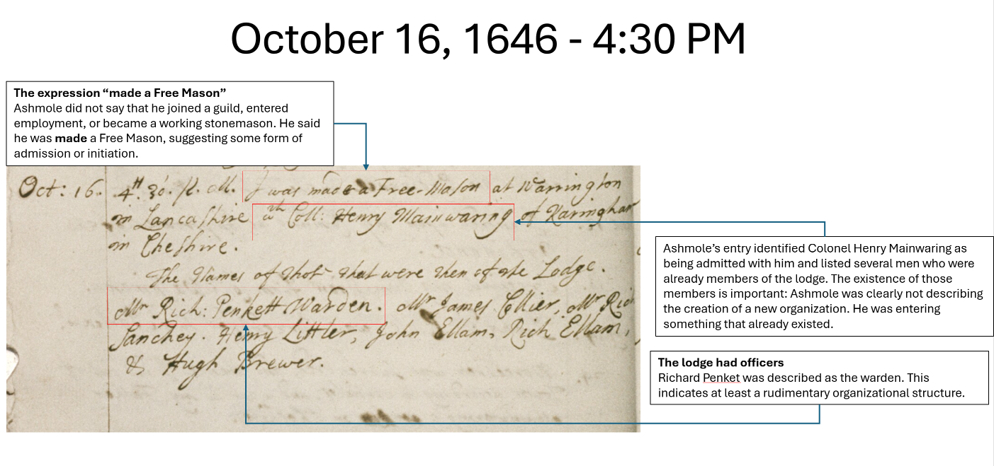
On October 16, 1646, Elias Ashmole wrote in his personal diary:
“I was made a Free Mason at Warrington in Lancashire.”
This entry predates the formation of the first Grand Lodge by more than 70 years, raising an important question:
What kind of Freemasonry existed in England in 1646?
Ashmole’s diary provides clues:
- He was made a Free Mason — not hired as a stonemason or admitted to a guild.
- The lodge already had members, indicating an established organization.
- It had officers, including a warden named Richard Penket.
- Ashmole was clearly entering a structure that already existed.
Ashmole’s Second Recorded Lodge Meeting (1682)
On March 10, 1682, Ashmole received a summons to attend a lodge at Masons’ Hall in London. The next day, he witnessed several men being admitted into what he called the “Fellowship of Free Masons.”
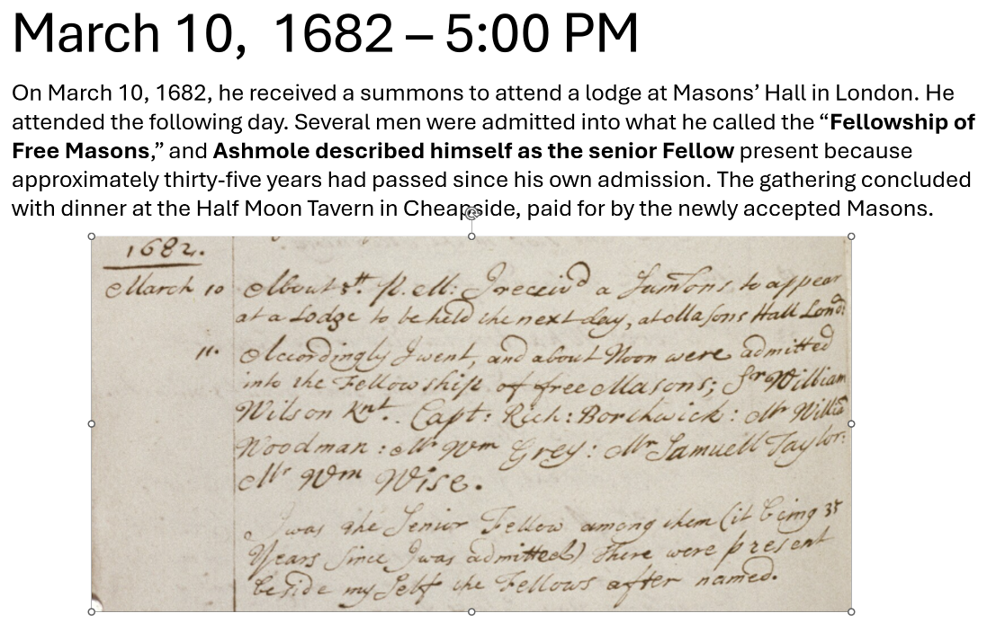
Ashmole noted that he was the senior Fellow present, having been made a Mason 35 years earlier. The meeting concluded with dinner at the Half Moon Tavern in Cheapside, paid for by the newly accepted brethren.
These entries show continuity, organization, and ritual — long before the Grand Lodge era.
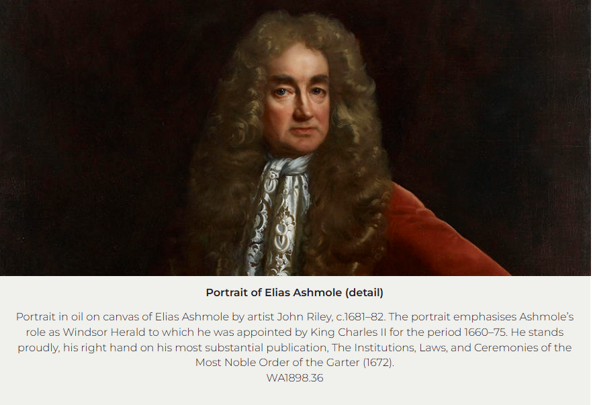
Who Was Elias Ashmole?
Born in 1617 in Lichfield, Staffordshire, Ashmole was a man of extraordinary intellect and curiosity. His interests included:
- English history & antiquities
- Heraldry & genealogy
- Astrology & astronomy
- Alchemy & natural philosophy
- Botany & collecting
- Court ceremony & chivalric orders
During the English Civil War, he supported the Royalist cause and later became one of the early Fellows of the Royal Society (1661), placing him among the leading thinkers of Restoration England.
The Ashmolean Museum
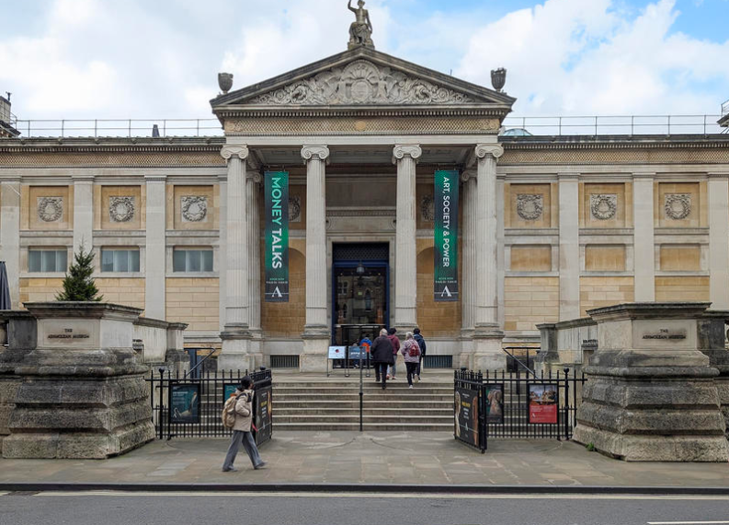
Ashmole’s passion for learning led him to donate his vast collection of natural curiosities to Oxford University. His words capture his dedication:
“I Elias Ashmole…have amass’d together great variety of naturall Concrets & Bodies, & bestowed them on the University of Oxford.” (Statutes, Orders & Rules, 1686)
The Ashmolean Museum, opened in 1683, is widely recognized as the first modern museum.
A Lesson for Today’s Freemasons
Freemasonry teaches us to explore symbolism and ritual — but also to serve those in need. Our duty extends beyond intellectual study:
- To relieve the distressed
- To support brothers, widows, and orphans
- To leave a legacy greater than ourselves
Ashmole embodied this balance. Though wealthy, educated, and respected, he entered the Craft as a candidate, seeking admission just as every Mason does.
His example reminds us:
Our fraternity is greater than any one man.
Reflecting on Ashmole’s Legacy
Ashmole was:
- Highly educated
- Wealthy
- Respected
- Connected
- Admired
Yet he:
- Entered the Craft humbly
- Experienced the same initiation as all candidates
- Sought admission, not privilege
His life teaches us that character, not status, defines a Mason.
R² — A Simple Masonic Formula
What can we learn from Ashmole?
R² = Live Respected + Die Regretted
Giving generously — to our lodge, our community, and our fellow man — is the surest way to achieve both.