Euclid’s Elements
For more than two millennia, one book has influenced thinkers, leaders, scientists, and philosophers more than almost any other—second only to the Bible. That book is Euclid’s Elements.
Written around 600 BCE, Elements is far more than a geometry textbook. It is a complete system for thinking clearly, reasoning rigorously, and transforming confusion into understanding. Its impact reaches far beyond mathematics, touching the worlds of science, law, philosophy, and even Freemasonry.
Euclid’s Method: A Foundation of Western Thought
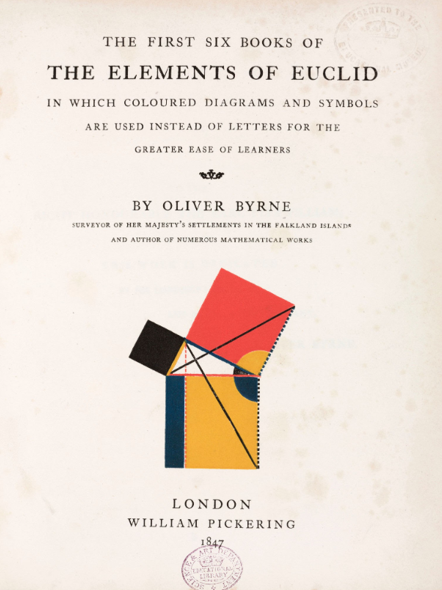
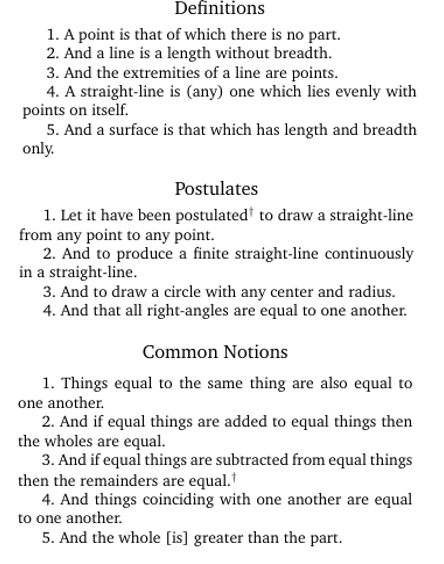
Oliver Byrne’s 1847 edition of Elements—famous for its colored diagrams—captures the timeless clarity of Euclid’s approach. His definitions, postulates, and common notions form the backbone of logical reasoning:
“A point is that of which there is no part.” “A line is a length without breadth.” “The whole is greater than the part.”
These simple statements became the seeds of an intellectual revolution.
Euclid and Freemasonry: A Shared Heritage
The connection between Euclid and Masonry is ancient. The Halliwell Manuscript (~1390), one of the earliest known Masonic documents, mentions Euclid repeatedly:
“This great clerk’s name was Euclid… He should teach the simplest of wit… And love together as sister and brother.”
The manuscript credits Euclid with establishing the craft of geometry in Egypt and teaching the foundations of the seven liberal sciences. For centuries, Masons have looked to Euclid as a symbol of order, clarity, and the disciplined pursuit of truth.
REBIS and the Duality of Opposites
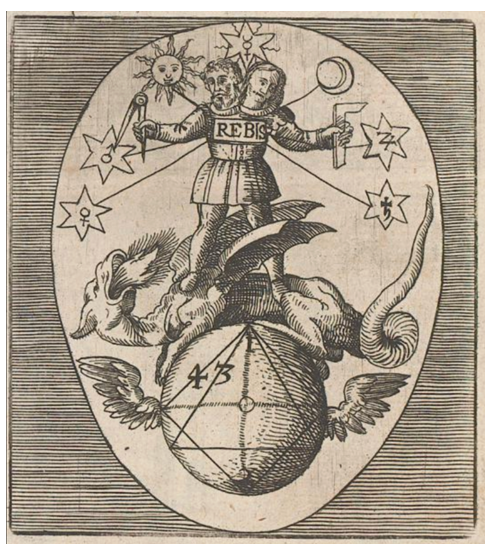
The 1613 alchemical image of the Rebis—the “divine hermaphrodite”—represents the union of opposites: square and compasses, matter and spirit, masculine and feminine. Euclid’s geometric purity and the Rebis’ symbolic duality together illustrate a core Masonic principle:
Harmony emerges when opposites are balanced.
Euclid’s Influence on Great Thinkers
Abraham Lincoln
As a young lawyer, Lincoln struggled to understand why he lost cases he believed he should have won. He turned to Euclid—not for geometry, but for logic. He carried Elements everywhere, using it to learn how to strip arguments down to their axiomatic core.
Albert Einstein
At age 12, Einstein received Elements and called it his “Holy Geometry Book.” Euclid taught him how to think axiomatically—an approach that later shaped the foundations of modern physics.
Albert Pike
In Morals and Dogma, Pike uses Euclidean principles to explain symbolism, structure, and perfection. His discussion of the cube—its faces, lines, and sacred numbers—reveals how deeply Euclid’s thinking influenced Masonic philosophy.
What These Men Had in Common
- They were brilliant in their own right.
- They thought differently than most people.
- They learned to think axiomatically.
Genius is often just rigorous logic applied to chaotic problems.
Why Euclid Matters Today
Euclid’s Elements has quietly shaped the minds of people who shaped the world. Its influence extends far beyond geometry:
- It teaches how to break complexity into clarity.
- It provides a timeless method for reasoning.
- It offers a way to navigate chaos with structure and purpose.
In a world that often feels overwhelming, Euclid gives us a simple question: